-
 Vitamin B17
Deficiency.
World
without Cancer - G. Edward Griffin.
Movie and audio transcript
- Fascinating Info!
Vitamin B17
Deficiency.
World
without Cancer - G. Edward Griffin.
Movie and audio transcript
- Fascinating Info!
This year 350,000
Americans will die from cancer. One out of three to
four of us will develop cancer in our lifetime.
That's over 50 million people in the United States
alone.
The purpose of this
presentation is to show that this great human
tragedy can be stopped now entirely on the basis of
existing scientific knowledge.
We'll explore the theory
that cancer, like scurvy or pellagra, is a
deficiency disease aggravated by the lack of an
essential food compound in modern man's diet and
that its ultimate control is to be found simply in
restoring this substance to our daily intake.
We are not in the
business of promoting vitamins, food supplements or
products of any kind. We're not prescribing any
course of treatment. We endorse nothing, except
freedom of choice. We have nothing to sell, but
facts.
What you're about to
hear does not carry the approval of organized
medicine. The Food and Drug Administration, the
American Cancer Society and the American Medical
Association have labelled it fraud and quackery.
The average physician,
however, is less dogmatic. He's more apt to say:
"Let's give it a try and then pass judgement!"
Consequently, an increasing number of doctors all
over the world now are testing and proving in their
own clinics that the vitamin concept of cancer is
true.
With billions of dollars
spent each year on research, with other billions
taken in from the cancer-related sale of drugs and
with vote-hungry politicians promising
ever-increasing government programs we find that
today there are more people making a living from
cancer, than are dying from it. If the riddle were
to be solved by a simple vitamin, this gigantic
commercial and political industry could be wiped out
overnight. The result is that the science of cancer
therapy isn't nearly as complicated as the politics
of cancer therapy.
ONGOING PERSECUTION
In the past the FDA and other agencies of
government have used every means at their disposal
to prevent this story from being told. They've
arrested citizens for holding public meetings to
tell others of their convictions on this subject.
They've confiscated
films and books. They even now are prosecuting
doctors, who apply these theories in an effort to
save the lives of their own patients.
With this background in
mind it may appear to be the height of folly to
proceed with this presentation. But ladies and
gentlemen, if the story that follows is true, - as
we firmly are convinced, it is - then in the name of
humanity someone simply has to stand up against the
bureaucracy and we are determined to do it!
Greatest Discoveries Often
Rejected, Maligned Or Suppressed By Scientific
and Medical Establishment:
The history of science is the
history of struggle against entrenched error.
Many of the world's greatest discoveries
initially were rejected by the scientific
community and those, who pioneered those
discoveries, often were ridiculed and condemned
as quacks and charlatans.
Columbus was bitterly
attacked for believing, the Earth was round. Bruno
was burned at the stake for claiming, the Earth was
not the center of the universe. Galileo was
imprisoned for teaching that the Earth moved around
the Sun. Even the Wright brothers were ridiculed and
condemned for claiming that a machine could fly
above the Earth.
In the
field of medicine Andreas Vesalius was denounced
as an impostor and heretic because of his
discoveries in the field of human anatomy.
William Harvey was disgraced as a physician for
believing that blood was pumped by the heart and
actually moved around the body through arteries.
And Ignaz Semmelweis was fired from his hospital
post for requiring his maternity staff to wash
their hands.
Scurvy:
Centuries ago it wasn't unusual
for entire naval expeditions to be wiped out by
scurvy. Between 1600 and 1800 the casualty list
of the British Navy alone was over one million
sailors. Medical experts of the time were
baffled, as they searched in vain for some kind
of a strange bacterium, virus or toxin that
supposedly lurked in the dark holds of ships.
And yet for hundreds of years the cure was
already known and written in the record.
In the winter of 1535,
when the French explorer Jacques Cartier found his
ships frozen in the ice off the St. Lawrence River,
scurvy began to take its deadly toll. Out of a crew
of one hundred and ten, twenty-five already had died
and most of the others were so ill, they weren't
expected to recover. And then a friendly Indian
showed them the simple remedy. Tree bark and needles
from the white pine - both rich in ascorbic acid or
vitamin C - were stirred into a drink, which
produced immediate improvement and swift recovery.
Upon returning to Europe, Cartier reported this
incident to the medical authorities. But they were
amused by such "witch-doctor cures of ignorant
savages" and they did nothing to follow it up.
Yes, the cure for scurvy
was known. But because of scientific arrogance it
took over two hundred years and cost hundreds of
thousands of lives, before the medical experts
began to accept and apply this knowledge.
Finally in 1747 John Lind, a young surgeon's mate in
the British Navy discovered that oranges and lemons
produced relief from scurvy and recommended that the
Royal Navy include citrus fruits in the stores of
all its ships. And yet, it still took forty-eight
more years, before his recommendation was put into
effect.
Pellagra:
The twentieth century has proven
to be no exception to this pattern. Only a
generation ago large portions of the American
Southeast were decimated by the dread disease of
pellagra, which was thought to be contagious and
probably caused by an as yet undiscovered virus.
As far back as 1914 Dr. Joseph Goldberger had
proven that this condition was related to diet
and later showed that it could be prevented
simply by eating liver or yeast. But it wasn't
until the 1940s - almost thirty years later -
that the medical world fully accepted pellagra
as a vitamin B deficiency.
By 1952 Dr. Ernst T. Krebs,
Jr., a biochemist in San Francisco
had advanced the
theory that cancer, like scurvy or pellagra,
is not caused by some kind of mysterious
bacterium, virus or toxin, but is merely a
deficiency disease aggravated by the lack of
an essential food compound in modern man's
diet. He identified this compound as part of
the nitriloside family, which occurs
abundantly in nature in over twelve hundred
edible plants and found virtually in every
part of the world. It's particularly prevalent
in the seeds of fruits, but also is contained
in grasses, maize, sorghum, millet, cassava,
linseed, bitter almonds and many other foods
that generally have been deleted from the
menus of modern civilization.
A chronic
disease is one,
which usually doesn't pass away of its own
accord.
A metabolic
disease is one,
which arises within the body and isn't
transmittable to another person.
Cancer therefore is
defined as a chronic, metabolic disease.
Dr. Krebs has pointed
out that in the entire
history of medical science there hasn't been one
chronic, metabolic disease that was ever cured
and prevented by drugs or mechanical
manipulation of the body. In every
case the ultimate solution was found only in factors
relating to adequate nutrition. And he thinks that
this is an important clue as to where to concentrate
our scientific curiosity in the search for a better
understanding of cancer.
Animals Natural Instinct:
But there are other clues, as
well. Before looking at the more technical
aspects of Dr. Krebs's theory, it's well that we
examine some of them. For example, domesticated
pets often seek out certain grasses to eat, even
though they're adequately filled by other foods.
This is particularly likely to happen, if the
animals are not well. It's interesting to note
that the grasses selected by instinct are
Johnson grass, Tunis grass, Sudan grass and
others that are especially rich in nitrilosides
or vitamin B17.
Monkeys and other
primates at the zoo, when given a fresh peach or
apricot, will carefully pull away the sweet, fleshy
part, crack open the hard pit and devour the small
seed that remains. Instinct compels them to do this,
even though they've never seen that kind of fruit
before. These seeds are one of the most concentrated
sources of nitrilosides to be found anywhere in
nature.
Wild bears are great
consumers of nitrilosides in their natural diet. Not
only do they seek out berries that are rich in this
substance, but when they kill small grazing animals
for their own food, instinctively they pass over the
muscle portions and consume first the viscera and
rumen, which are filled with nitriloside grasses.
In captivity, animals
seldom are allowed to eat all the foods of their
instinctive choice. In the San Diego Zoo, for
example, the routine diet for bears, although
adequate in volume and nutritious in many other
respects, is almost totally devoid of nitrilosides.
In one grotto alone over a six-year period five
bears died of cancer. It was generally speculated by
the experts that a virus had been the cause.
Now, it's highly
significant that one never finds cancer in the
carcasses of wild animals killed in the hunt. These
creatures contract the disease only, when they are
domesticated by man and forced to eat the foods that
he provides and the scraps from his table.
Dr. George M. Briggs,
professor of nutrition at the University of
California has said: "The typical American diet is a
national disaster ... If I fed it to pigs or cows
without adding vitamins and other supplements, I
could wipe out the livestock industry."
The American Diet:
A brief look at the American diet
tells the story. Grocery shelves now are lined
with high-carbohydrate foods that have been
processed, refined, synthesized, artificially
flavored and loaded with chemical preservatives.
Some manufacturers even boast of how little real
food there is in their product.
Millet once was the
nation's staple grain. It is high in nitriloside
content. But now it's been replaced by wheat, which
has practically none at all. Sorghum cane has been
replaced by sugar cane with the same result. Even
our cattle are fed increasingly on quick-growing,
low-nitriloside grasses, so there's less vitamin B17
residue in the meat we eat. In some places livestock
now are being fed a diet containing fifteen percent
paper to fatten them quicker for market.
And so we
see that in the past 50 years the foods, that
once provided the American people with ample
amounts of natural vitamin B17, gradually have
been pushed aside or replaced altogether by
foods almost devoid of this factor.
Significantly it's during this same time span
that the cancer rate has moved steadily upward
to the point, where today one out of every four
persons in the United States is destined to
contract this disease.
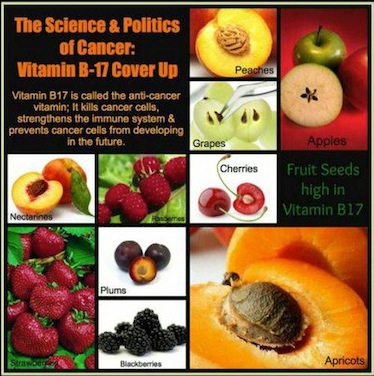
Various
Tribes Who Eat Rich-Nitriloside Foods, Have
No Cancer:
The ultimate scientific test of
the vitamin theory of cancer would be to take a
large number of people numbering in the
thousands and over a period of many years expose
them to a consistent diet of rich-nitriloside
foods and then check the results. Fortunately
this already has been done. In the remote
recesses of the Himalaya Mountains between West
Pakistan, India and China there is a tiny
kingdom called Hunza. These people are
known world over for their amazing longevity and
good health. It's not uncommon for Hunzakuts to
live beyond a hundred years and some even to a
hundred and twenty or more. Visiting medical
teams from the outside world report that there
never has been a case of cancer in Hunza.
Although presently
accepted science is unable to explain, why these
people should be free of cancer, it's interesting to
note that the average Hunza diet contains over
two-hundred times more nitriloside, than the average
American diet. In fact, in that land, where there is
no such thing as money, a man's wealth is measured
by the number of apricot trees he owns. And the most
prized of all foods is considered to be the apricot
seed. It's also interesting to learn that when the
Hunzakuts leave their secluded land and adopt the
menus of other countries, they soon succumb to the
same diseases and infirmities - including cancer -
as the rest of mankind.
The Eskimos are
another people that have been observed by medical
teams for many decades and found to be totally free
of cancer. The traditional Eskimo diet is amazingly
rich in nitrilosides that come from the residue in
the meat of caribou and other grazing animals and
also from the salmon berry, which grows abundantly
in the Arctic areas. When the Eskimo abandons his
traditional way of life and begins to rely on
westernized foods, he becomes even more
cancer-prone, than the average American.
There are many other
peoples in the world that could be cited with the
same characteristics: the Abkhazians near
the Black Sea, the Hopi and Navajo
Indians of North America, certain native
populations in South America and South Africa.
From all races and all regions
of the world the one thing they have in common
is that the degree, to which these people are
free from cancer, is in direct proportion to the
amount of nitrilosides or vitamin B17 found in
their native diet.
In answer to this the
skeptic may argue that these primitive groups aren't
exposed to the same cancer-producing elements that
modern man is and perhaps that's why they're immune.
Let them breathe the same smog-filled air, smoke the
same cigarettes, swallow the same chemicals added to
their food or drinking water, use the same soaps or
deodorants and then see, how they fare! This, of
course, is a valid point. But fortunately even that
question now has been resolved by experience.
Thousands
Of People Have Altered Their Diet
Accordingly:
For over two decades there has
been a steadily growing group of people, who
have accepted the vitamin theory of cancer and
who have altered their diets accordingly. They
represent all walks of life, all ages, both
sexes and reside in almost every advanced nation
in the world. It's estimated that there are many
thousands in the United States alone.
Now it's true that
there's no way to determine their exact number or to
conduct clinical examinations on each of them. But
they do constitute a rather well defined group that
is both vocal and conspicuous. It's significant
therefore that after starting and maintaining a diet
rich in vitamin B17 none of these people has ever
been known to contract cancer.
Now let's repeat that
statement! While their fellow citizens are suffering
from cancer at the rate of one out of every four,
not one of these thousands has ever been known to
contract this dread disease.
For many persons the
logic of all these facts put together is so great
that it would be easy to close the case right here.
But in view of the powerful opposition against this
concept let's not content ourselves only with the
logic of the theory! Let's reinforce our convictions
with the science of the theory also, that we may
understand, why it works the way, our logic tells us
that it must.
John Beard, a
professor of embryology at the University of
Edinburgh in Scotland:
In 1902, John Beard reported that
there were no discernible differences between
highly malignant cancer cells and certain
pre-embryonic cells that were quite normal in
the early stages of pregnancy. In technical
terms these normal cells are called trophoblasts.
Extensive research had led Professor Beard to
the conclusion that cancer and trophoblast are
in fact one and the same. His theory therefore
is known as the trophoblastic thesis of
cancer.
The trophoblast in
pregnancy indeed does exhibit all the classical
characteristics of cancer. It spreads and multiplies
rapidly, as it eats its way into the uterus wall
preparing a place, where the embryo can attach
itself for maternal protection and nourishment.
The trophoblast is
formed as a result of a chain reaction starting with
another cell identified as the diploid totipotent.
For our purposes let's call this simply the "total-life"
cell, because it contains within it all the
separate characteristics of the complete organism
and has the total capacity to evolve into any organ
or tissue or for that matter into the complete
embryo itself.
About eighty percent of
these total-life cells are located in the ovaries or
testes, where they serve as a genetic reservoir for
future offspring. The rest of them are distributed
elsewhere in the body for a purpose not yet fully
understood, but which may involve the regenerative
or healing process of damaged tissue.
The hormone estrogen
is well known for its ability to effect changes in
living tissue. Although it's generally thought of as
a female hormone, it's found in both sexes and
performs many vital functions. Wherever the body is
damaged either by physical trauma, chemical action
or illness, estrogen always appears in great
quantities, possibly serving as a stimulator or
catalyst for body repair.
It's now known that the
total-life cell is triggered into producing
trophoblast, when it comes into contact with
estrogen. When this happens to those total-life
cells that have evolved from the fertilized egg, the
result is a placenta and umbilical cord, a means of
nourishing the embryo. But when it occurs
non-sexually as part of the general healing process,
the result is cancer.
When cancer begins to
form, the body reacts by attempting to seal it off
and surrounding it with cells that are similar to
those in the location, where it occurs. A bump or
lump is the usual result. Under microscopic
examination most of these tumors are found to
resemble a mixture or hybrid of both trophoblast and
surrounding cells; a fact, which has led many
researchers to the premature conclusion that there
are many different types of cancer.
But the
degree, to which various tumors appear to be
different, is the same degree, to which they're
benign; which means that it's the degree, to which
there are non-cancerous cells within it.
The greater the
malignancy, the more these tumors begin to resemble
each other and the more clearly they begin to take
on the classic characteristics of pregnancy
trophoblast. And the most malignant of all cancers,
the chorionepitheliomas, are almost
indistinguishable from trophoblast cells. For, as
Dr. Beard pointed out over seventy years ago,
they're one and the same.
Let's turn now to the
question of defense mechanisms! Before we can hope
to conquer cancer, first we must understand, how
nature conquers cancer, how nature protects the body
and controls the growth of trophoblast cells.
White Blood Cells:
All animals contain billions of
white blood cells. One of the functions of these
cells is to attack and destroy anything that is
foreign and harmful to our bodies. For this
reason it would seem logical that they would
attack cancer cells, also. But since cancer is
trophoblast and since trophoblast is not foreign
to the body, but is in fact a vital part of the
life cycle, nature has provided it with a very
effective means of avoiding the white cells.
One of
the characteristics of the trophoblast is that
it's surrounded by a thin protein coating that
carries a negative electrostatic charge. The white
cells also have a negative charge. And since similar
polarities repel each other, the trophoblast
is well protected.
Enzymes:
Part of the solution to this
problem is found in the pancreas, which secretes
an enzyme called
trypsin. When this enzyme reaches
the trophoblast in sufficient quantity, it
digests the protective protein coat. The cancer
then is exposed to the attack of the white cells
and it dies.
Applying this to the
embryo we find that the trophoblast cells there
continue to grow and spread right up to the eighth
week. And then suddenly with no apparent reason they
stop growing and are destroyed. Recent research has
provided the explanation. It's in the eighth week
that the baby's pancreas begins to function.
Now
it's significant that the upper intestines - near
the point, where the pancreas empties into it - is
the one place in the human body, where cancer is
almost never found.
We note also that diabetics -
those, who suffer from a pancreas malfunction
- are three times more likely to contract
cancer, than non-diabetics. These
facts, which have puzzled medical investigators for
years, at last can be explained in light of the
trophoblastic thesis of cancer.
But what happens, if the
pancreas is weak or if the rate of cancer growth is
so high that the enzyme trypsin can't keep up with
it? Then what?
The answer is that
nature has provided a backup mechanism, a second
line of defense, that can do the job, even if the
first line should fail. It involves a unique
chemical compound that poisons the malignant cell,
while nourishing all the rest. And this is, where
the vitamin concept of cancer finally comes back
into the picture.
The
chemical compound in question, of course, is
vitamin B17, which is found in those natural foods
containing nitrilosides. It's known also as amygdalin
and as such has been used and studied extensively
for well over a hundred years. But in its
concentrated and purified form developed by Dr.
Krebs specifically for cancer therapy it is known
as Laetrile. For the sake of clarity in
this presentation, however, we shall favor the
more simple name: vitamin B17.
The B17 molecule
contains two units of sugar, one of benzaldehyde
and one of cyanide, all tightly locked
together within it. Now, as everyone knows, cyanide
can be highly toxic and even fatal, if taken in
sufficient quantity. However, locked as it is in
this natural state, it's completely inert chemically
and has absolutely no effect on living tissue.
There is only one
substance that can unlock this molecule and release
the cyanide. That substance is an enzyme called
beta-glucosidase, which we shall call the
"unlocking enzyme". When B17 comes in contact with
this enzyme, not only is the cyanide released, but
also the benzaldehyde, which is highly toxic by
itself. In fact, these two working together are at
least one hundred times more poisonous, than either
of them separately. The unlocking enzyme is not
found to any dangerous degree anywhere in the body,
except at the cancer cell, where it always is
present in great quantity. The result is that
vitamin B17 is unlocked at the cancer cell. It
becomes poisonous to the cancer cell and only to the
cancer cell.
There's another
important enzyme called rhodanese, which we
shall identify as the "protecting" enzyme. The
reason is that it has the ability to neutralize
cyanide by converting it instantly into by-products
that actually are beneficial and essential for
health. This enzyme is found in great quantities in
every part of the body, except the cancer cell,
which consequently is not protected.
Here then is a
biochemical process that destroys cancer cells,
while at the same time nourishes and sustains
non-cancer cells. It's an intricate and perfect
mechanism of nature that simply couldn't have been
accidental.
Carcinogens:
There's much speculation today
about carcinogens, the things that supposedly
cause cancer. We're told that researchers now
have proven that smoking or excessive exposure
to the sun or chemical additives to our food or
even certain viruses all can cause cancer. But
as we have seen, the
real cause is an enzyme and vitamin
deficiency. These other things
merely are the specific triggers that start the
process.
Anything that produces
prolonged stress or damage to the body can trigger
off the production of estrogen as a part of the
healing process. If this goes unchecked, because the
body lacks the necessary chemical ingredients to
fight back, then the result is cancer.
Specific carcinogens
therefore do not cause cancer. They merely
determine, where it's going to occur.
Combination Of Defense
Against Cancer:
Of course, nature's defenses
against cancer include more, than just the
pancreatic enzymes and vitamin B17. Research has
shown that an important role also may be played
by other enzymes, other vitamins, oxygenation of
the blood, pH levels and even body temperature.
Vitamin B17 seems to be the most vital and
direct-acting of all these factors, but none of
them can be ignored, for they're an
interlocking part of the total natural
mechanism.
Fortunately, it's not
necessary for man to understand fully every
theoretical aspect of this mechanism, in order to
make it work for him in practice. All that he really
needs to know is the necessity of eating foods rich
in all the vitamins and minerals and of minimizing
damage or stress to the body.
The reality
of the vitamin B17 concept of cancer has been
proven in the laboratory beyond any doubt. For
example, Dr. Dean Burk, head of the
Cytochemistry Section of the National Cancer
Institute, has reported that in a series of
tests on animal tissue the B17 had no effect on
normal cells, but released so much cyanide and
benzaldehyde, when it came in contact with
cancer cells that not one of them could survive.
Dr. Burk
said: "When we add
Laetrile to a cancer culture under the
microscope, we can see the cancer cells
dying off like flies."
World
Without Cancer, B17 - Part Two
When is it too late to begin? -
Laetrile.
©2002-2025
Chi Energy International.
SOQI Health Magazine - World Without
Cancer.
Disclaimer
// Copyright
// About